

The Nerve That Changes Everything
It decides whether you heal or stay inflamed, and how to train it.

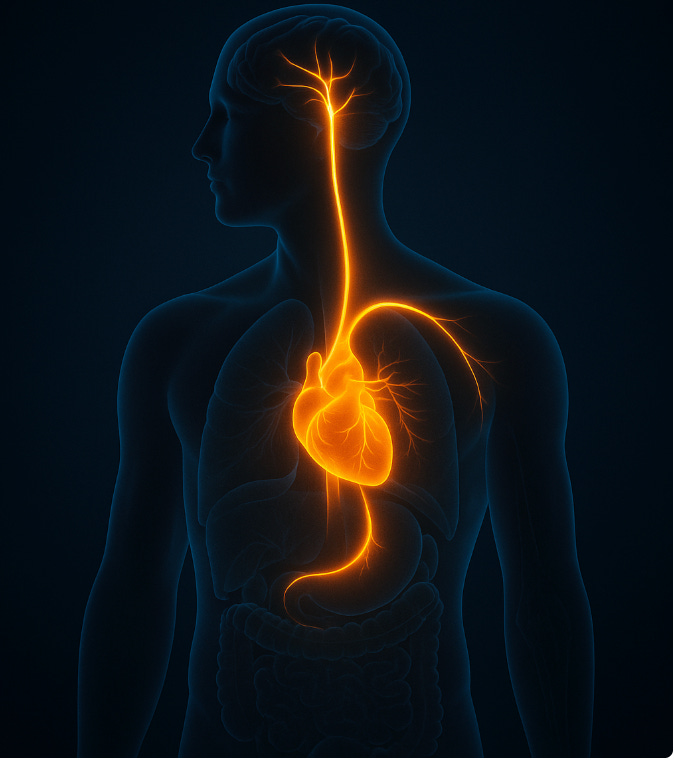
When I first learned anatomy in medical school, the vagus nerve was just another name on a long list:
cranial nerve number ten, the wandering nerve, running from the brainstem through the heart, lungs, and gut.
Back then, it was memorization.
Now, it has taken on quite a bit of meaning.
Years later, when I began studying inflammation, autoimmunity, and the nervous system, I realized something extraordinary:
This “wandering nerve” is one of the body’s most powerful communication highways, carrying messages between the brain and nearly every organ.
It slows the heart rate.
Calms inflammation.
Regulates digestion.
Balances the stress response.
In short, it’s the physical bridge between body and mind.
And in truth, we can’t fully heal without it.
As I began looking closer, I noticed a pattern: many people with chronic illness, such as autoimmunity, gut disruption, and mood imbalances, had low vagal tone.
So did I.
Could this be part of what was keeping us from healing?
I had to go deeper.
Once I truly understood that, my entire approach, to my own health and to my medical practice, changed.
I stopped seeing healing as chemistry alone.
It became about communication.
Because the messages our nervous system sends every moment determine whether we live in defense or repair, in survival or restoration.
The Body’s Built-In Reset Button
Here’s what’s fascinating: the vagus nerve runs automatically, moment to moment, day and night, quietly regulating your heartbeat, digestion, and inflammation without you ever thinking about it.
But unlike most autonomic nerves, we can actually influence it.
That’s what makes it so extraordinary.
Through our breath, our voice, and even our exposure to nature’s elements, we can consciously tune a system that usually runs on autopilot.
We can shift our state from stress to calm, not with willpower, but through physiology.
The vagus doesn’t just send messages out from the brain; it also brings constant feedback back in.
It listens.
It tracks the rhythm of your heart, the stretch of your gut, the activity of your immune system, and tells the brain whether you’re safe.
When it’s strong and well-tuned:
Digestion runs smoothly: stomach acid, enzymes, and bile flow all depend on it.
The gut lining stays sealed and nourished.
The adrenals know when to dial down cortisol.
The bladder coordinates contraction and release with ease.
The immune system stays balanced, suppressing runaway inflammation
When vagal tone is low, everything loses harmony: digestion slows, stress hormones rise, inflammation lingers, and the body stays stuck in “fight or flight.”
But the best part? We can train it back into balance.
Training the Vagus: Communication as Medicine
We can even measure how well this nerve is working through heart rate variability (HRV), the subtle variation in time between heartbeats.
Your heart has its own pacemakers, but the vagus nerve also modulates every beat.
When the vagus is active, it slows the heart slightly from beat to beat, increasing HRV.
That variability reflects flexibility, resilience, and longevity.
Low HRV means the body is stuck in survival mode.
High HRV means it’s adaptable: calm yet ready, steady yet flexible.
And we can strengthen it through small daily rituals that use our breath, our voice, and even temperature to remind our nervous system: you’re safe now.
There’s a simple art to training this nerve, one that rewires how your body responds to stress, inflammation, and calm.
Subscribe to continue reading
and learn how to train your calm, rewire your stress response, and activate your body’s built-in healing nerve: to lower inflammation, improve digestion, and restore balance throughout your body.